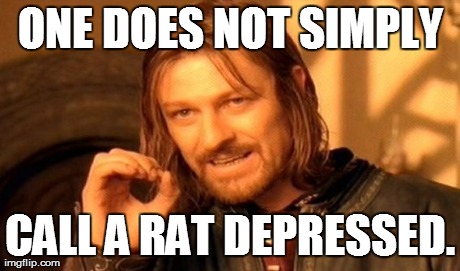
Last time, I mentioned that I wanted to try something new with my "Learning and Memory" class. They have a paper due at each exam which essentially requires them to summarize the notes, give a real-life example of the concepts, and then describe how this can help them in their future careers.
I told them that they can substitute an internet meme for this assignment at any time. I feel that the ability to find humor in your discipline, and express it pictorially, lets me know that students have a decent grasp on that concept. What could be more real-life than comedy?
Having said that, here is the first student submission. I laughed so hard!
Thursday, January 31, 2013
Wednesday, January 23, 2013
Behaviorism strikes again!
| If I had a dollar for everytime I got called out on this during grad school... |
I'll post some of them on my blog as they get generated. I'm looking forward to seeing what they come up with.
Tuesday, January 22, 2013
Successful innovations
Our college was the recipient of a Title III grant, which provides funding for technology infrastructure. On top of getting some *sweet* iPads, we as faculty were encouraged to apply the use of technology in classes to increase student engagement. The program encouraging this at York College is called Successful Innovations.
This past Fall, a joint brain-child of mine and Mrs. Kroeker's was to do some kind of experiment. I am, after all, trained as a researcher. Mrs. Kroeker had the idea about using text messages as a medium to study social psychology. Particularly, have you ever gotten a text message that you just weren't sure about?
"We need to talk."
"What was that about?"
You know...ambiguous text messages.
This fit in well with our section about situational and dispositional attributions, and the fundamental attribution theory.
For example- "We need to talk." ... Is it someone being controlling (dispositional)? Or does the sender need to fill you in on the latest drama (situational)?
Our 26 students of Social Psychology developed a survey containing 10 ambiguous text messages similar to the ones above. They also provided one situational and one dispositional explanation for each. Participants from YC came up to our workspace to receive anonymous text messages (sent by psych students using the free TextNow app) on their personal devices and complete the survey. 59 students ended up participating: over 10% of the YC student body! Combining that number with the number of enrolled Social Psych students brought our total number of students involved to nearly 20% of the YC population! Talk about student engagement...
Though our findings weren't clear, and it was most students' first attempt at running a study, I would call this a success in terms of training and experience for Psych majors. Two of our students presented the findings to the students, faculty, and staff at Chapel. Three other students presented the findings at the Nebraska Psychological Society meeting - the first time YC has presented any research at NPS!
We are proud of how much time and effort YC Psychology students put into this project. I am hopeful that we can continue this line of inquiry in future experiments!
This past Fall, a joint brain-child of mine and Mrs. Kroeker's was to do some kind of experiment. I am, after all, trained as a researcher. Mrs. Kroeker had the idea about using text messages as a medium to study social psychology. Particularly, have you ever gotten a text message that you just weren't sure about?
"We need to talk."
"What was that about?"
You know...ambiguous text messages.
This fit in well with our section about situational and dispositional attributions, and the fundamental attribution theory.
For example- "We need to talk." ... Is it someone being controlling (dispositional)? Or does the sender need to fill you in on the latest drama (situational)?
Our 26 students of Social Psychology developed a survey containing 10 ambiguous text messages similar to the ones above. They also provided one situational and one dispositional explanation for each. Participants from YC came up to our workspace to receive anonymous text messages (sent by psych students using the free TextNow app) on their personal devices and complete the survey. 59 students ended up participating: over 10% of the YC student body! Combining that number with the number of enrolled Social Psych students brought our total number of students involved to nearly 20% of the YC population! Talk about student engagement...
Though our findings weren't clear, and it was most students' first attempt at running a study, I would call this a success in terms of training and experience for Psych majors. Two of our students presented the findings to the students, faculty, and staff at Chapel. Three other students presented the findings at the Nebraska Psychological Society meeting - the first time YC has presented any research at NPS!
We are proud of how much time and effort YC Psychology students put into this project. I am hopeful that we can continue this line of inquiry in future experiments!
Monday, January 21, 2013
Six months later...one semester down!
I'm still alive! Surviving a snowy day in Nebraska, and learning about the use of technology in teaching (#yorkMLK13). I've gotten a lot of ideas and inspiration today, including using turning student professional portfolios into blogs, student-generated memes for Learning and Memory, the use of Twitter (I'm @ycpsych), personal branding, and flipped classrooms.
It's a good time to remind myself how to blog, for personal branding purposes and to process the semester's goings-on.
My first semester of full-time teaching (and department chair!) consisted of three and a half seated courses, two guided studies, and serving on the HLC committee for accreditation. Two of those classes were classes I'd never taught before, so that was really intense.
Now, second semester in, I'm teaching 5 classes (two of which are new for me to teach, though the material is not new), two guided studies, two online courses. I've got plenty of time to blog! :)
Did I mention how much I love my job? I'm having so much fun. Living the dream!
It's a good time to remind myself how to blog, for personal branding purposes and to process the semester's goings-on.
My first semester of full-time teaching (and department chair!) consisted of three and a half seated courses, two guided studies, and serving on the HLC committee for accreditation. Two of those classes were classes I'd never taught before, so that was really intense.
Now, second semester in, I'm teaching 5 classes (two of which are new for me to teach, though the material is not new), two guided studies, two online courses. I've got plenty of time to blog! :)
Did I mention how much I love my job? I'm having so much fun. Living the dream!
Wednesday, August 1, 2012
Score!
Our local library had a booksale fundraiser a couple of weekends ago. You could fill a brown bag for $5 or a paper box for $10. Boy, I sure cleaned up. For practically nothing, I was able to stock my (new, and slightly empty) bookshelves with such gems as:
"On Death and Dying" by Kubler-Ross
"Voyage of the Beagle" by Darwin
A pocket-size DSM-IV (outdated, but useful in its own right)
An 8-volume Encyclopedia of Psychology (must have been just before Wikipedia completely blew up)
"Sex and Temperament" and "Culture and Commitment" by Margaret Mead
"Go ask Alice"
"Searching for Memory" by Daniel Schacter
as well as a few young-adult and popular books on the topics of animal rights, genetics, technology and social psychology, general audience counseling books.
Now, my bookshelves look a lot more interesting.
Speaking of technology and social psychology, I'm thinking about offering a special-topics course in the next year or so on this very topic. I read Sherry Turkle's book "Alone Together: Why we expect more from technology and less from each other" and thought it was a really great starting point for getting students to think about how heavily we rely on batteries that run on devices. If you're interested in Turkle's work, may I recommend her TED talk:
"On Death and Dying" by Kubler-Ross
"Voyage of the Beagle" by Darwin
A pocket-size DSM-IV (outdated, but useful in its own right)
An 8-volume Encyclopedia of Psychology (must have been just before Wikipedia completely blew up)
"Sex and Temperament" and "Culture and Commitment" by Margaret Mead
"Go ask Alice"
"Searching for Memory" by Daniel Schacter
as well as a few young-adult and popular books on the topics of animal rights, genetics, technology and social psychology, general audience counseling books.
Now, my bookshelves look a lot more interesting.
Speaking of technology and social psychology, I'm thinking about offering a special-topics course in the next year or so on this very topic. I read Sherry Turkle's book "Alone Together: Why we expect more from technology and less from each other" and thought it was a really great starting point for getting students to think about how heavily we rely on batteries that run on devices. If you're interested in Turkle's work, may I recommend her TED talk:
Thursday, July 5, 2012
Brain art
Was browsing The Beautiful Brain for some art to save as my computer's desktop and found some lovelies:
It was hard to choose, but I started with the top one, since it has so much orange in it. I love orange.
Friday, June 22, 2012
Psychoanalysis and cucumbers...
My brain just took a left turn on that one, but anyway. There's no escaping the ever-present stereotype of Freudian Psychoanalysis. Not even on my kids' DVDs.
Larry the Cucumber explores his love for his lips with the asparagus-therapist.
Subscribe to:
Posts (Atom)